
From Blueprint to Beta: Inside the Making of the
EXPEDITIO Academy

Author:
Borut Razbornik
SMART Institute
Every good educational method eventually needs a home.
Over the past year, the URBAN EXPEDITIO partnership has developed an approach that combines Adventure Learning with AI-supported treasure hunts. It turns streets, squares and city landmarks into active learning environments.
However, describing a method in a handbook is only the first step. Teachers also need a place where they can quickly find the materials, adapt them to their city and use them with students.
Creating that place was SMART Institute’s responsibility. As the partner leading Work Package 3, we developed the EXPEDITIO Academy: an online platform that brings together the project’s learning materials, training modules and AI-supported Toolbox.
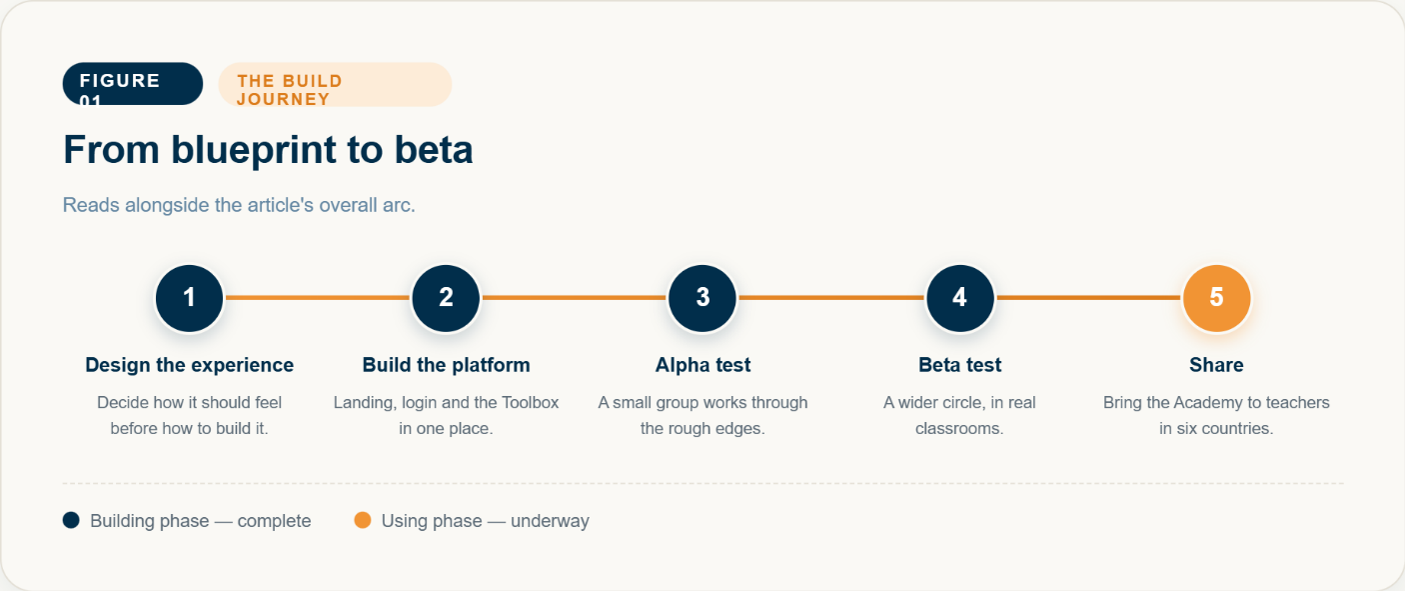
This is the story of how the Urban Expeditio Academy moved from an empty design canvas to a tested and working platform.
Starting with the experience, not the software
When developing an online platform, it can be tempting to open a digital tool and start building immediately.
We deliberately began somewhere else.
Our first task was to design the learning environment. Before choosing technical features, we considered what teachers should experience when they enter the Academy.
We asked practical questions:
What does a teacher need to understand within the first two minutes? How can someone unfamiliar with Adventure Learning quickly grasp the idea? Where should a busy educator go to find a ready-to-use activity? How can they create or adapt one of their own?
These questions helped us map the Academy before any page was built.
They also gave us a clear rule for every later decision: the technology should respond to teachers’ real needs, not simply reflect our preferences as developers.
The Toolbox as the heart of the Academy
The Toolbox is where teachers can find the project’s practical resources.
It includes indoor and outdoor treasure-hunt scenarios based on edutainment, Adventure Learning and the thoughtful use of AI. Teachers can adapt these activities to their own subject, city and group of students.
However, a collection of resources is only useful when people can find what they need quickly.
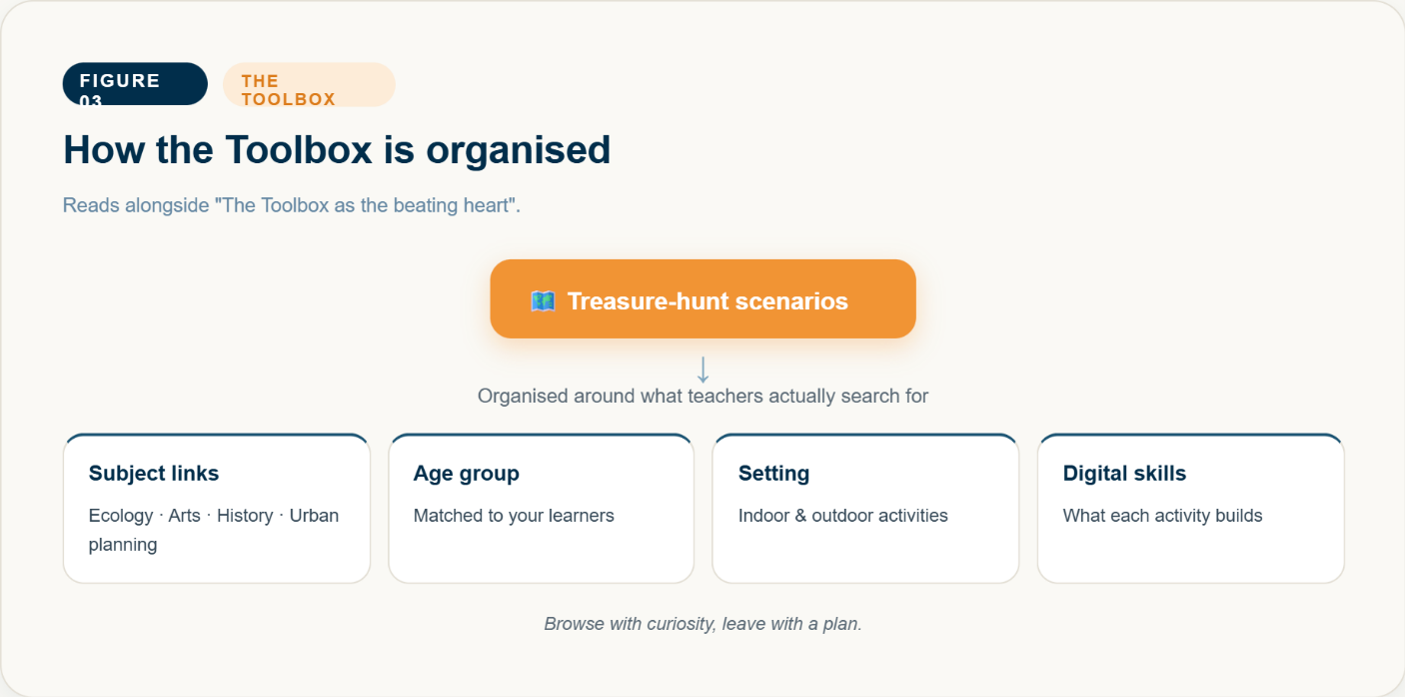
We therefore organised the Toolbox around the information teachers are most likely to search for:
- curriculum links, including ecology, arts, history and urban planning;
- the age of the learners;
- indoor or outdoor settings;
- the digital skills developed through the activity.
Each scenario is designed to be easy to understand and adapt. Teachers should be able to explore the Toolbox, select an activity and leave with a clear plan for their lesson.
Building for six countries at once
A platform created through a European partnership must work across different languages, school systems and educational contexts.
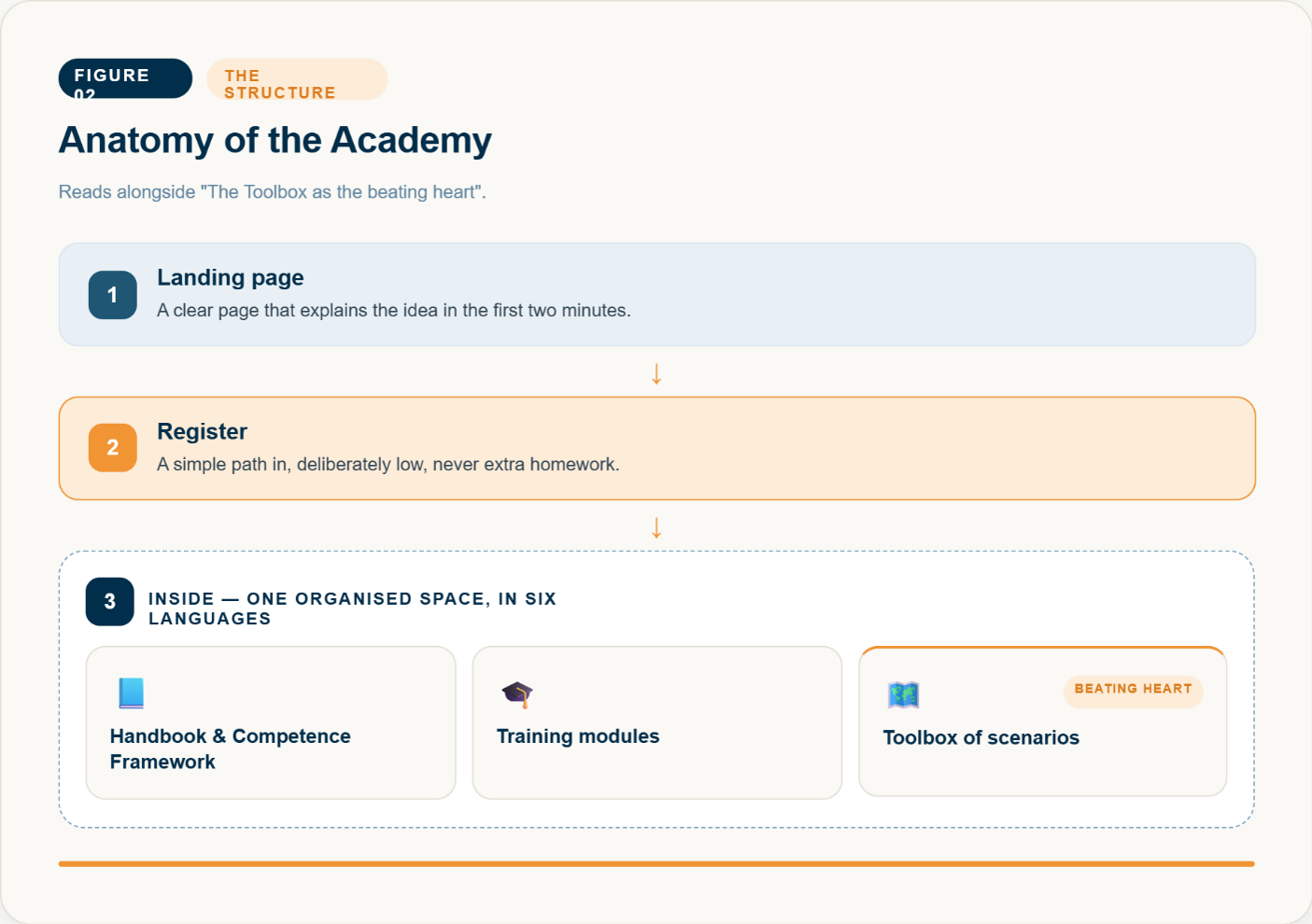
From the beginning, the Academy was designed to host content in the languages of all partner countries. This allows a scenario developed in one country to be understood, adapted and reused in another.
We also wanted to make the platform easy to enter.
Teachers already manage demanding workloads. They are unlikely to use a tool that feels like additional homework. For that reason, the Academy includes a clear landing page, a simple registration process and one organised space for all project materials.
The Teachers’ Handbook, Competence Framework, training modules and Toolbox are kept together rather than scattered across different links.
The technology should remain in the background. The learning method should be what teachers notice first.
Testing in two honest rounds
A platform may look effective during development, but its real value only becomes clear when people begin using it.
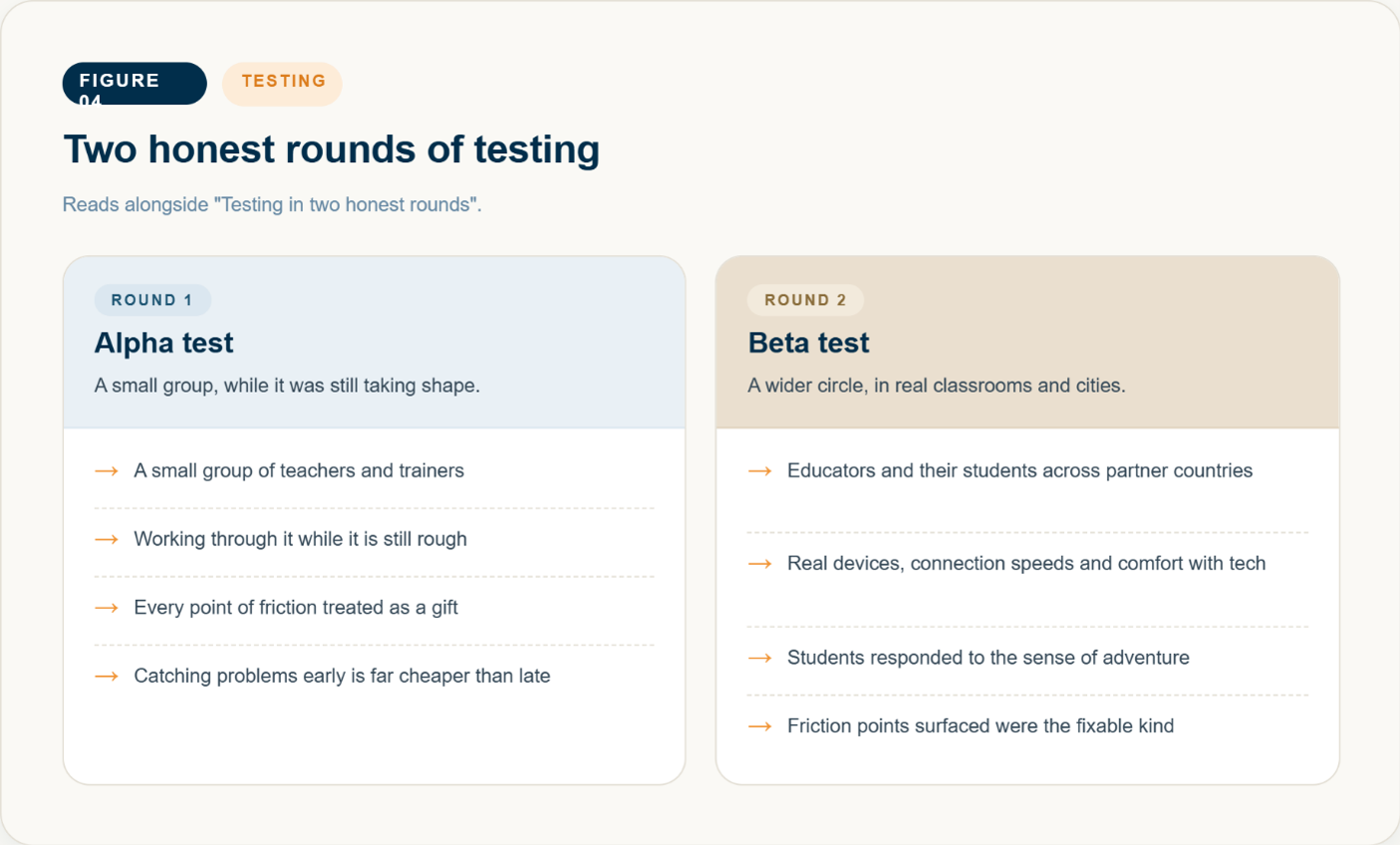
We therefore organised two testing rounds. This allowed teachers and students to shape the Academy before its final release.
The first round was an alpha test. A small group of teachers and trainers explored the platform while it was still being developed.
At this stage, we wanted to identify basic problems. Was the navigation clear? Were the instructions easy to follow? Could users find the materials they needed?
The testing revealed moments where buttons, steps or instructions were less obvious than we had expected. Rather than seeing these difficulties as failures, we treated them as useful feedback. Problems are much easier to correct when they are discovered early.
The second round was a beta test involving a wider group of educators and students across the partner countries.
This time, the Academy was tested in real educational settings. Participants used different devices, internet connections and levels of digital confidence. Students also took part in the treasure-hunt activities.
These experiences helped us understand how the platform worked outside our development team.
Teachers particularly valued having the method, training materials and practical tools in one place. Students responded positively to the sense of exploration and adventure.
The testing also revealed smaller obstacles that could be improved before the final version. That is exactly what a testing process should achieve.
What building it taught us
Three lessons stand out from the development process.
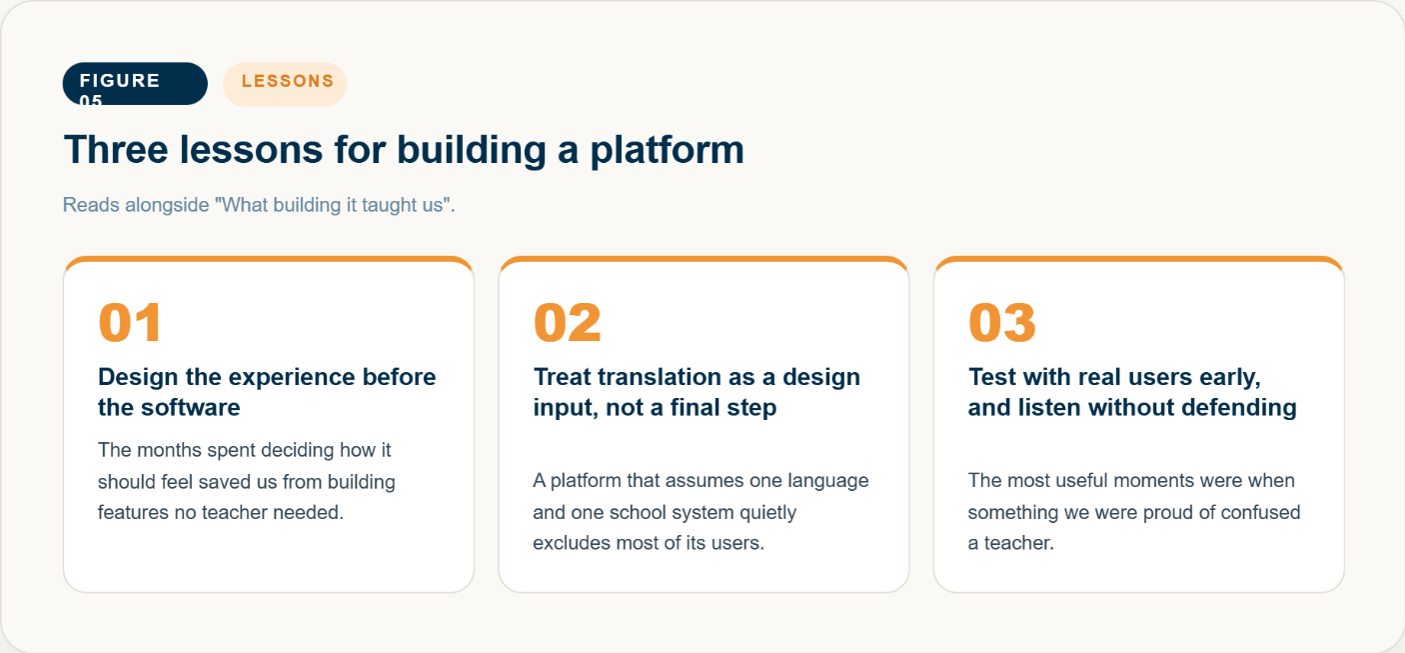
- Design the experience before the software
Before deciding what the platform should do, decide what the user should experience.
The time we spent mapping teachers’ needs prevented us from developing attractive features that would have added little practical value.
- Treat language and cultural differences as part of the design
Translation should not be left until the final stage.
A platform built around only one language or school system may unintentionally exclude many of its potential users. Multilingual and culturally adaptable content must be considered from the beginning.
- Test early with real users
The most useful feedback often came when something we considered clear confused a teacher or student.
Listening to users without immediately defending our choices allowed us to see the Academy from their perspective. That is how the platform improved.
Where this leads
The EXPEDITIO Academy now provides one working home for the project’s main results.
Teachers can access the Teachers’ Handbook and Competence Framework, complete the training modules and explore the Toolbox of treasure-hunt scenarios.
During the final months of URBAN EXPEDITIO, the focus will move from development to wider use. Partners will introduce the Academy to teachers through local events in six countries and share it with the broader education community.
An educational method creates a lasting impact only when other people can use it independently.
That is why we invested so much care in making the EXPEDITIO Academy clear, practical and adaptable.
The building phase is almost complete. The next phase begins when teachers open the Academy, adapt its resources and bring the method into their own classrooms and cities.